

Erwin Olaf | Early Works
In the coming weeks and into the new year, we will be sharing a series of curator texts on the life and work of Erwin Olaf, one of the most important artists of his generation.
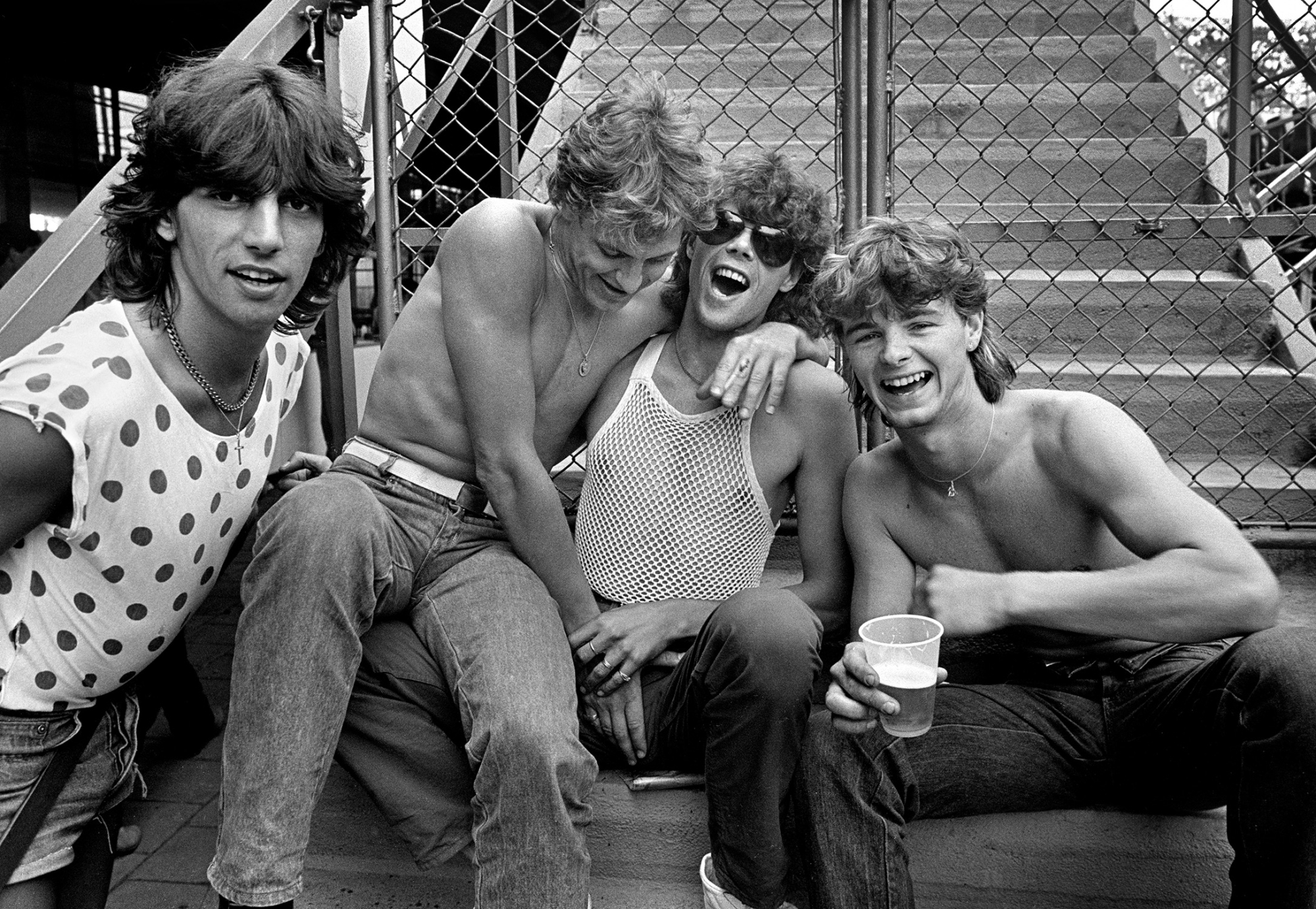
This first chapter looks at his early years as a photographer, focusing on his work on the streets of Amsterdam and within its nightlife and LGBTQ+ communities.
Read the full text by our curator, Lars Been, below.
Chapter 1: Street Photography
That camera was his protection. With his camera, Erwin dared to venture out into the world.
– Shirley den Hartog
From an early age, Erwin Olaf formed a special bond with his camera. It offered him protection and opened the door to unknown worlds. He was reserved by nature, but the camera allowed him to get close to people. He took to the streets of Amsterdam—often with friends—to capture protests and the city’s nightlife. His work in his early days as a journalist, for Sek, the magazine of the LGBTQ+ rights organization COC Nederland, and for Vrij Nederland magazine, took him to places that would shape both him and his later artistic practice. According to Shirley den Hartog the camera brought out another side of him: “Erwin was not someone who would just walk up to people. If he found someone interesting, there would be something that held him back—unless he had a camera with him. That gave him the freedom to approach people, and they would gladly open up to him.”
Even in risky situations, such as protests or riots, Olaf felt that the camera offered him protection. Den Hartog explains: “He once told me that he was present during the ‘Geen Woning, geen Kroning’ riots [‘No housing, no coronation’—the squatter protests that erupted during the inauguration of Queen Beatrix in 1980]. His then-boyfriend Teun and he were standing at the front, and he thought they were about to be arrested. The police arrived, looked at Teun and Erwin, and simply let them be—because of that camera.”
Hartog continues: “At one point, Vrij Nederland asked him to write a report on the S&M scene in the Netherlands—a world he knew nothing about and imagined to be full of eccentric characters, but he actually found them very pleasant. He said, ‘They were as nice as my mother!’ Assignments like that brought him into contact with a wide variety of people—and made him even more liberal.”
According to Charl Landvreugd, Olaf’s early photographs carry an emancipatory message: “There is now a whole generation of young gay people who have grown up in the freedom that Erwin and his generation fought so hard to secure. The photographs of protests against Cardinal Simonis—who faced strong opposition for his conservative statements on abortion, euthanasia, and homosexuality—are a good example of this. They make it clear that our current freedoms cannot be taken for granted.”
Olaf’s early work embodies his passionate struggle for freedom. With his photographs of an AIDS benefit evening or a Pink Saturday in Leiden, he takes us into the very heart of the queer community of that era. With images of gay bars and the S&M scene, he breaks taboos and asserts the right to live one’s own life, outside the norm. The freedom to love whoever you want and the freedom to be yourself—proud and without shame—are a common thread through Olaf’s oeuvre, even in the series from the end of his life.
ABOUT Erwin Olaf
Erwin Olaf (1959-2023) was known for his diverse practice that centered around society’s marginalized individuals, including people of color, and the LGBTQ+ community. In 2019, Olaf became a Knight of the Order of the Lion of the Netherlands after 500 works from his oeuvre were added to the collection of the Rijksmuseum. Taco Dibbits, Rijksmuseum director, called Olaf “one of the most important photographers of the final quarter of the 20th century”.
In 2018, Olaf completed a triptych of monumental photographic and filmic tableaux portraying periods of seismic change in major world cities, and the citizens embraced and othered by their urban progress. Like much of his work, it is contextualized by complex race relations, the devastation of economic divisions, and the complications of sexuality. Olaf maintained an activistic approach to equality throughout his 40-year career after starting out documenting pre-AIDS gay liberation in Amsterdam’s nightlife in the 1980s.
A bold and sometimes controversial approach earned the artist a number of prestigious collaborations, from Vogue and Louis Vuitton, to the Stedelijk Museum Amsterdam. He served as the official portrait artist for the Dutch royal family in 2017, and designed the national side of the euro coins for King Willem-Alexander in 2013. He was awarded the Netherlands’ prestigious Johannes Vermeer Award, as well as Photographer of the Year at the International Color Awards, and Kunstbeeld magazine’s Dutch Artist of the Year. In 2023, His Majesty the King Willem-Alexander awarded him the Medal of Honor for Art and Science of the Order of the House of Orange.
Erwin Olaf exhibited worldwide, including Centro de Arte Contemporáneo de Málaga, Málaga, Spain; Museu da Imagem e do Som, São Paulo, Brazil; Martin-Gropius-Bau, Berlin, Germany; Southeastern Center for Contemporary Art, Winston-Salem, North Carolina, USA; and Museo de Arte Contemporáneo, Santiago, Chile. In the spring of 2019, Olaf’s work was the subject of a double exhibition at Kunstmuseum The Hague and The Hague Museum of Photography, as well as a solo exhibition at the Shanghai Center of Photography. In 2021, Erwin Olaf had his first solo exhibition Im Wald at Galerie Ron Mandos and mounted a large survey exhibition at Kunsthalle München, Germany.
Olaf’s work is included in numerous private and public collections, such as the Rijksmuseum and Stedelijk Museum, both in Amsterdam, The Netherlands; Fonds National d’Art Contemporain, Paris, France; Museum Ludwig, Cologne, Germany; Museum Voorlinden, Wassenaar, The Netherlands; North Carolina Museum of Art, Raleigh, United States; Art Progressive Collection, United States; and the Pushkin Museum, Moscow, Russia.
Visit the artist’s website here.


