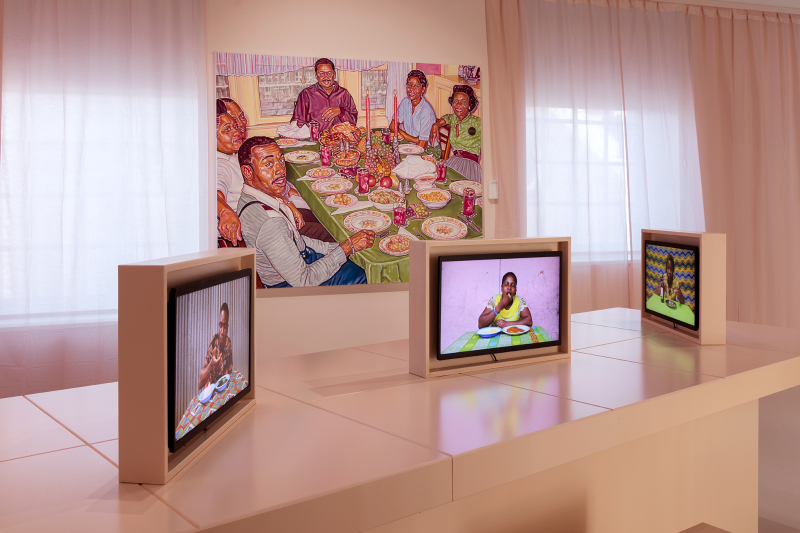
Stedelijk Museum Collection Exhibition 1980 – Now
The Stedelijk Museum, Amsterdam recently opened their new collection exibition Tomorrow is a Different Day. This exhibition showcases works made from 1980 onwards, and features work by Remy Jungerman, Esiri Erheriene-Essi and Marcos Kueh.
READ MOREThe Stedelijk Museum showcases world-famous works and new discoveries in modern and contemporary art and design. Their collection can be experienced in three parts, based on current themes through the years. Tomorrow is a Different Day spotlights art and design from the collection, from 1980 to the present, by international artists and designers who are helping to shape the changes of today and tomorrow. They challenge the status quo and offer alternative perspectives.
Featured in the presentation are the works Miss Contamination Cultura (Mother Mary the New Diety) and Domesticana Sarawakana (Exotic HouseKeeping) (2022) by Marcos Kueh, Barricade (2014) by Esiri Erheriene-Essi and Promise IV (2018-2019) by Remy Jungerman. Other works on show are by Martine Syms, Julie Mehretu, Marlene Dumas, Natasja Kensmil, Igshaan Adams, Carrie Mae Weems, Anne Imhof, Jeff Koons, Nan Goldin, Steve McQueen, and more.
—
Tomorrow is a Different Day. Collection 1980 – Now
Stedelijk Museum, Amsterdam
Ongoing
See more


ABOUT Remy Jungerman
Remy Jungerman (1959) lives and works in New York and Amsterdam. He attended the Academy for Higher Arts and Cultural Studies in Paramaribo, Suriname, before moving to Amsterdam where he studied at the Gerrit Rietveld Academy.
In his work Jungerman explores the intersection of pattern and symbol in Surinamese Maroon culture, the larger African diaspora, and 20th century Modernism. Placing fragments of Maroon textiles and other materials found in the African diaspora—the kaolin clay used in several religious traditions or the nails featured in Nkisi Nkondi power sculpture—in direct contact with materials and imagery drawn from more ‘established’ art traditions, Jungerman presents a peripheral vision that enriches our perspective on art history.
In 2022 Jungerman received the A.H. Heineken Prize for Art.
From November 20, 2021 – April 10, 2022 he was the subject of a career survey show at the Stedelijk Museum, Amsterdam titled Remy Jungerman: Behind the Forest.
In 2019 he represented the Netherlands at the 58th Venice Biennale in 2019.
In 2008 he received the Fritschy Culture Award from the Museum het Domein, Sittard, The Netherlands.
His international residencies include Art Omi, International Studio & Curatorial Program (ISCP) in New York and Tembe Art Centre, Moengo, SR.
His work has been featured in numerous publications and acquired by various institutions and private collectors worldwide including Stedelijk Museum Amsterdam, Kunstmuseum The Hague, and International African American Museum (IAAM), Charleston, US. His first book, Where the River Runs, published by Jap Sam Books in 2019, won the 2019 50books | 50covers design award from the AIGA in the US and has received two 2019 30 Best Dutch Book Designs awards. His second book, Behind the Forest, was published by Jap Sam Books in 2021 in connection with his solo exhibition at Stedelijk Museum Amsterdam. His third book, Tracing the Lines: Patterns of the African Diaspora was published by Jap Sam Books in 2024.
Visit the website of the artist here.
ABOUT Esiri Erheriene-Essi
Born in 1982 in London, United Kingdom
Lives and works in Amsterdam, The Netherlands
Esiri Erheriene-Essi is predominately a painter of mid to large-scale paintings concerned with figuration, history and society. She is captivated by history – in particular, images, objects, and documents which we can return to, in order to examine both individual and shared memories and histories. A large part of her practice entails collecting and creating an archive, which could potentially become incorporated into her work. Archives are important to the artist as they create links and orders that she can question and play with – she searches for the discrepancies, the silences, in order to, through painting, create interruptions and assaults on the canonical historical narrative. With hindsight, bias and curiosity, she takes these discordances and brings them up to the surface. Erheriene-Essi continuously re-edits the narratives with the hope of robbing history of some of its tyrannical power by creating new scenarios. Or rather, she is incessantly attempting to imagine more humane and liberating narratives than what has gone before. In the process she perhaps slightly changes our readings of history and thereby shows how we write the present.
In her work, Erheriene-Essi makes many references to popular culture, because popular culture is profoundly mythic and loaded. The canvases she makes are a theatre of popular desires and fantasies, where we all can discover and play with the process of identification. These ‘theatrical scenes’ show the imagined as well as the underrepresented, not only to the viewer but also to the artist herself. The paintings ‘play’ in their own way – they are telling a story, even though the scenes have no beginning, middle or end – they are cut off mid flow, out of context, are frozen, silent and still. Yet they have ‘sound’ as if they are performing and want to be heard. The audience is continuously invited to watch as well as to try and decipher the haphazard plot in which characters are encased in. The good thing about performing on canvas is that anything is possible – and that is what intrigues Erheriene-Essi the most.
ABOUT Marcos Kueh
Born 1995 in Malaysia.
Lives and works in The Netherlands
Marcos Kueh is a textile artist from the Island of Borneo, with a professional background in Graphic Design and Advertising. His love affair with textiles started two years ago in his Academy’s textile workshop, while trying to find a sense familiarity to grasp onto while studying in the Netherlands. The ancestors of his land encapsulated their dreams, myths and hopes in their textiles. Many of Kueh’s textile works are explorations and speculations of the traditional meaning of the craft in the contemporary context. His practice has motivated him to work and learn about both the traditional weaving techniques back in Borneo and the ‘modern’ industrial weaving mills here in the Netherlands.
Marcos Kueh graduated from The Royal Academy of Art (KABK) in The Hague in 2022. He participated in the Best of Graduates 2022 exhibition at Galerie Ron Mandos, during which Joop van Caldenborgh, founder of Museum Voorlinden, awarded him the Young Blood Award of 2022. In October of 2022, Kueh started the Ron Mandos Young Blood Foundation Residency at the BRUTUS Lab in Rotterdam. His studio will be opened to visitors during Art Rotterdam 2023, running from February 8th to 12th. Currently, his work is also on view at Museum Voorlinden, Wassenaar, NL, and Stedelijk Museum, Amsterdam, NL. Previously, Marcos Kueh had exhibitions at Osaka International Art Fair, Osaka, JP; Architectural Biennal Rotterdam, NL; Kazerne, Eindhoven, NL, and The Backroom, Kuala Lumpur, MY.